
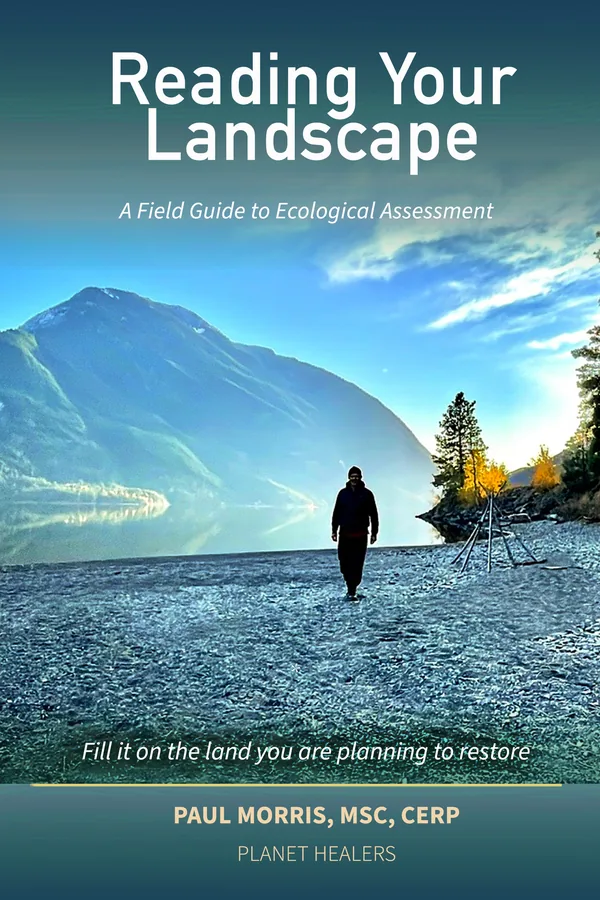
2.1 Reading your landscape
Seven readings from Reading Your Landscape. Do them on foot, on one piece of land you can come back to.
1. The first walk
The quality of what you observe in the first ten minutes of arriving somewhere sets the quality of everything that follows.
Read
Reading Your Landscape
Watch
https://www.youtube.com/watch?v=5vf5-X55O_o
Do
Exercise 0: walk the edge of your land slowly for ten minutes without writing. Stand still in the middle for five. Then finish the guide's sentences in your journal.
2. Reading soil
Bare soil is a wound.
Read
Reading Your Landscape
Watch
Video coming soon.
Do
Do the knife compaction test and the can infiltration test (500 ml of water) in one spot. Write down the depth and the time.
3. Reading water
Healthy landscapes absorb rain; degraded landscapes shed it.
Read
Reading Your Landscape
Watch
Video coming soon.
Do
Walk from the highest point to the lowest, stopping every 20 to 30 m. Sketch where water would go, and mark the wettest, driest and in-between zones.
4. Reading the plant community
The most important question in restoration is: what should this be?
Read
Reading Your Landscape
Watch
https://www.youtube.com/watch?v=bUdN8eVD33U
Do
Note which of the five layers are on your site and which are missing. Then name your reference ecosystem: the best-kept example of what your land would be.
5. Reading birds
Birds are the most accessible real-time indicator of ecosystem health available.
Read
Reading Your Landscape
Watch
https://www.youtube.com/watch?v=A14xHvypb7s
Do
Do a 15-minute Merlin walk across your site. Log the birds you can confirm.
6. Reading disturbance history
The most valuable disturbance history is often held by people, not documents.
Read
Reading Your Landscape
Watch
https://www.youtube.com/watch?v=5-a0hnEt7A8
Do
Scroll back through Google Earth's historical imagery for your site. Then ask one long-time neighbour what this land was used for when they were young.
7. Putting it together
Restoration that starts with the most constraining factor tends to succeed.
Read
Reading Your Landscape
Watch
Video coming soon.
Do
Write your site narrative: the past, the present, the direction. End with the one thing this land most needs right now.
8. Building your 100 species
Landscapes reveal themselves slowly to those who pay attention, and generously to those who come back.
Read
Reading Your Landscape
Watch
Video coming soon.
Do
Start with the five plants you walk past every day and the birds you hear every morning. Log 10 species.
- 1The first walk
- 2Reading soil
- 3Reading water
- 4Reading the plant community
- 5Reading birds
- 6Reading disturbance history
- 7Putting it together
- 8Building your 100 species