
4.2 Running a workshop
Three workshops you can take off the shelf and teach, and the follow-up that tells you what landed. From the Workshop Design Kit.
1. Plan the route
Five stopping points with one good question each is better than twenty stops with prepared lectures.
Read
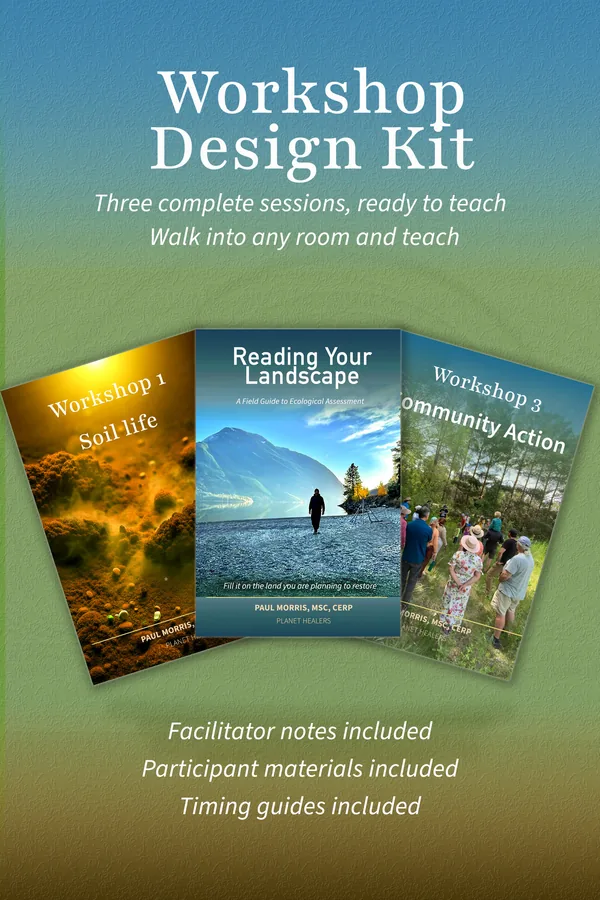
The Workshop Design Kit
Watch
Video coming soon.
Do
Find a place with a worn-out patch and a healthier one nearby. Walk it, choose your five stops, and write the one question you'll ask at each. Find one piece of history on the ground to be your anchor story.
2. What happened to this place?
To shift participants from seeing landscape as scenery to reading it as a story, with a history, a current condition, and a direction of travel.
Read
The Workshop Design Kit
Watch
Video coming soon.
Do
Run the two-hour workshop on your route for at least three people. In the closing circle, write down what each person said they're taking away.
3. Reading the land
The assessment answers four questions: what happened here, what condition is the site in now, what is the site trying to become, and what does it need from us to get there faster.
Read
The Workshop Design Kit
Watch
https://www.youtube.com/watch?v=wUy5BYv9iuQ
Do
Run the half-day site assessment on real land with at least two pairs. Write the group's predictions at the start, then check them against what the pairs found.
4. From seed to ground
Hold up the smallest seed you have and ask "what is this?"
Read
The Workshop Design Kit
Watch
https://www.youtube.com/watch?v=-TSvNuiNqOQ
Do
Run the propagation workshop, or just its morning half. First pick your five teaching plants: a pioneer, a nitrogen-fixer, an insectary plant, a keystone tree and a rare local species.
5. The follow-up
What did you notice this month that you wouldn't have noticed before the workshop?
Read
The Workshop Design Kit
Watch
Video coming soon.
Do
Within 48 hours of your workshop, send everyone the summary and your contact details. A month later, send the one question and note the answers.