
5.4 Planning a project
Turn what you know about the site into a plan: goals, a species list, and the first two years. From the Project Planning Template, the Community Restoration Toolkit and FER Practice.
1. Context and assessment
Perfect is the enemy of good in restoration planning: a completed rough assessment beats an unfinished detailed one every time.
Read
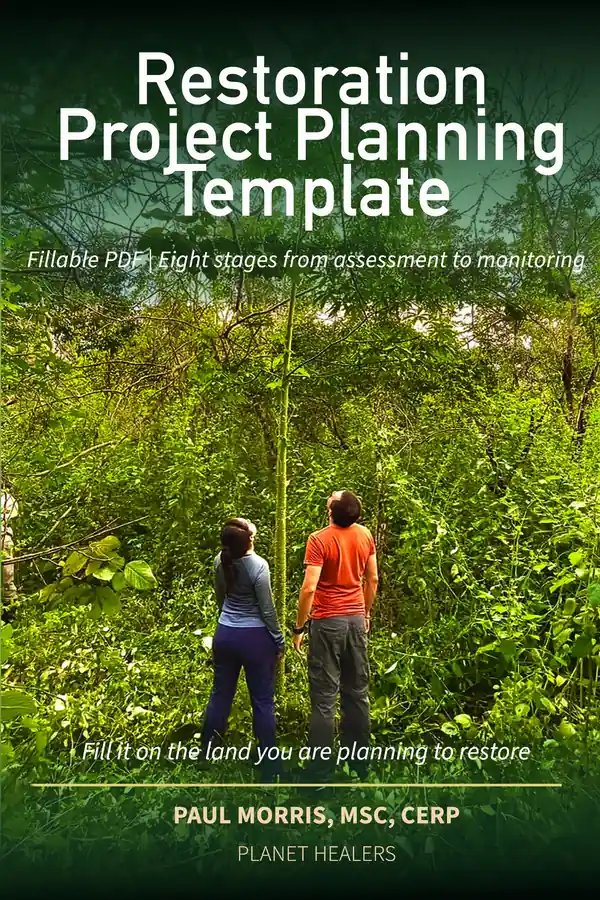
Restoration Project Planning Template
Watch
Video coming soon.
Do
Fill in Stages 1 and 2 of the template for your site, in one sitting and one field visit. Rough is fine. Write down the three biggest things you learned.
2. Goals and objectives
Goals give you direction. Objectives give you specifics.
Read
Fundamentals of Ecosystem Restoration: Practice, Chapter 56
Watch
Video coming soon.
Do
Write one goal for your site and three objectives under it, each with a number and a date. Then write whose values shaped them.
3. Your species list
The most important criterion in species selection is not what looks best or what is easiest to source. It is local provenance.
Read
The Community Restoration Toolkit
Watch
Video coming soon.
Do
Build your species list in three tiers: 5 to 8 foundation species, 8 to 15 diversity species, and 3 to 5 accent species for Year 3 or later. Note a local source for each.
4. The first two years
The planting day is not the project. The project is the two years of management that follow it.
Read
The Community Restoration Toolkit
Watch
Video coming soon.
Do
Write your Year 1 plan: who waters and when, how you'll keep 30 cm clear around each plant, how you'll protect against browsing, and how many replacement plants you'll keep ready.